Published: 1 Dec 2025 | Updated: 28 Jan 2026


Ever watched a French roulette table and wondered why the game feels more deliberate, formal, and rule-driven than other variants?
The answer lies largely with the croupier. In French roulette, the dealer is not simply spinning the wheel—they actively manage verbal bets, enforce traditional rules, and apply outcomes like La Partage and En Prison with precision. Their role is central to how the game functions and why it is widely regarded as one of the fairest forms of online roulette available today.
In this article, you’ll learn:
- What makes the croupier’s role in French roulette different from other variants
- How spoken bets and table traditions shape dealer responsibilities
- Why zero outcomes require direct croupier intervention
- How professional standards protect players in regulated environments
French roulette follows a formal structure rooted in tradition, with clearly defined procedures that differ from other roulette tables. Many of these rely on the croupier’s actions rather than automated systems alone—particularly in formats that support announced wagers, often referred to as call bets.
These traditions are now preserved not only in land-based casinos but also in regulated live roulette environments streamed from licensed studios.
|
Disclaimer: This content is for educational purposes only. It does not promote gambling or suggest outcomes. All roulette results are random. Play responsibly. 18+. For support, visit BeGambleAware.org. |
The Croupier’s Core Responsibilities in French Roulette
French roulette operates at a slower, more structured pace than many modern roulette variants. Before examining specific mechanics, it’s important to understand how the croupier anchors the entire game flow.
At a French roulette table, the croupier is responsible for:
- Opening and closing betting rounds with clear verbal calls
- Accepting and confirming both table and announced bets
- Spinning the wheel and releasing the ball impartially
- Monitoring correct chip placement on even-money wagers
- Applying special rules following zero outcomes
Whether played in a physical venue or an online casino environment, these responsibilities ensure consistency, transparency, and fairness across every spin.
Managing Spoken and Announced Bets
One defining feature of French roulette is the acceptance of spoken or announced bets, which increases the croupier’s level of direct involvement.
Before discussing payouts, it’s important to understand how these bets affect dealer responsibility.
When handling announced wagers, the croupier must:
- Listen carefully to the player’s declaration
- Verbally acknowledge the bet
- Place chips correctly on the layout
- Confirm the wager meets table requirements
Because these bets are placed verbally rather than physically, the croupier’s attentiveness is essential. This contrasts with many table games where bets are placed directly by the player without verbal confirmation.
Applying Zero Rules: La Partage and En Prison
French roulette’s lower house advantage is closely tied to how zero outcomes are handled—an area where the croupier plays a decisive role.
When the ball lands on zero, the croupier applies one of two traditional rules:
- La Partage, where even-money bets lose only half their stake
- En Prison, where qualifying bets are held over to the next spin
These outcomes are managed manually. Chips are split, held, or returned according to the rule in effect, preserving the game’s published house edge and ensuring mathematical consistency.
Table Pacing and Formal Game Flow
French roulette is intentionally unhurried. Before exploring regulatory oversight, it’s worth understanding how pacing reinforces clarity and control.
The croupier sets the tempo by:
- Allowing sufficient time for announced bets
- Clearly signalling betting closure
- Avoiding rushed spins
- Maintaining consistent intervals between rounds
This structured rhythm reduces betting errors and benefits players using mobile interfaces or casino apps, where clarity and timing are especially important.

Fairness, Oversight, and Professional Standards
Although outcomes are random, the croupier ensures that every round is conducted fairly and transparently.
In regulated live casino environments, croupiers are trained to:
- Enforce strict bet-timing rules
- Resolve disputes through formal procedures
- Remain neutral regardless of outcomes
- Operate under continuous camera and supervisory oversight
These safeguards help protect players and reinforce responsible participation alongside broader responsible gaming measures.
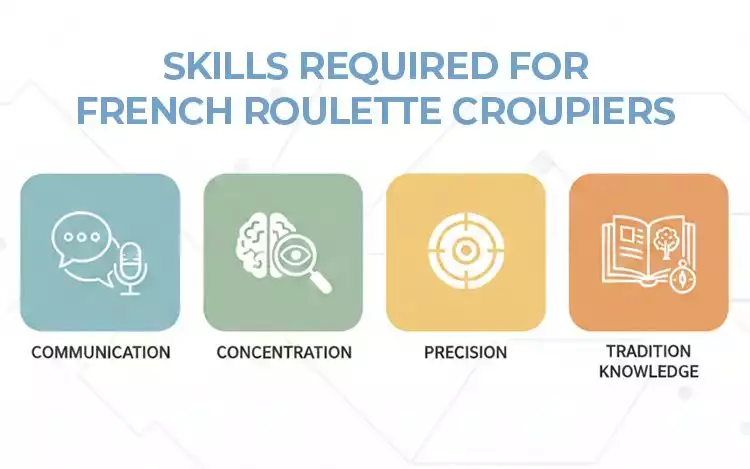
Skills Required for French Roulette Croupiers
French roulette demands a specialised skill set that goes beyond mechanical dealing.
Key competencies include:
- Clear verbal communication for announced bets
- Sustained concentration during slower rounds
- Familiarity with traditional betting structures
- Precision when managing partial losses and held bets
While croupiers may understand common roulette strategy concepts, they never influence outcomes or recommend betting systems. Their role is strictly procedural.
Conclusion
The croupier is the defining presence at a French roulette table. More than a dealer, they are the custodian of tradition, fairness, and procedural accuracy.
Key takeaways:
- French roulette relies heavily on verbal and manual dealer actions
- Zero outcomes require direct croupier intervention
- Slower pacing improves clarity and player confidence
- Professional standards uphold fairness in both land-based and live formats
To explore licensed French roulette tables, live dealer formats, and current promotions, visit Prime Casino.
18+ | Play Responsibly