Published: 7 Nov 2025 | Updated: 26 Jan 2026


Have you ever wondered why the French version of roulette is widely regarded in cultural history as elegant and mathematically structured?
Because it was born not merely as a game, but as a by-product of science — a 17th-century experiment in mathematics, motion, and chance that became a living lesson in fairness.
In this article, you’ll discover:
- How Blaise Pascal’s scientific curiosity inspired the world’s most famous wheel
- Why French salons turned chance into a rational pastime
- The unique rules that made French Roulette historically reduced house edge figures than other variants
- How French laws, morality, and innovation shaped its evolution
- Why the French design still defines fairness in modern casino play
|
Disclaimer: This content is for educational purposes only. All modern roulette and table game outcomes are determined by certified RNGs or audited live wheels. 18+ | Play responsibly. |
The Origins and Evolution of French Roulette
From its earliest mechanical experiments to its modern live casino incarnation, the story of French Roulette is inseparable from France’s cultural and intellectual heritage. What began in the 17th century as a scientific pursuit became a reflection of Enlightenment values — rationality, balance, and moral order. This section traces that journey from Pascal’s invention to Monte Carlo’s preservation of the French ideal of fairness.
Pascal and the Science of Chance
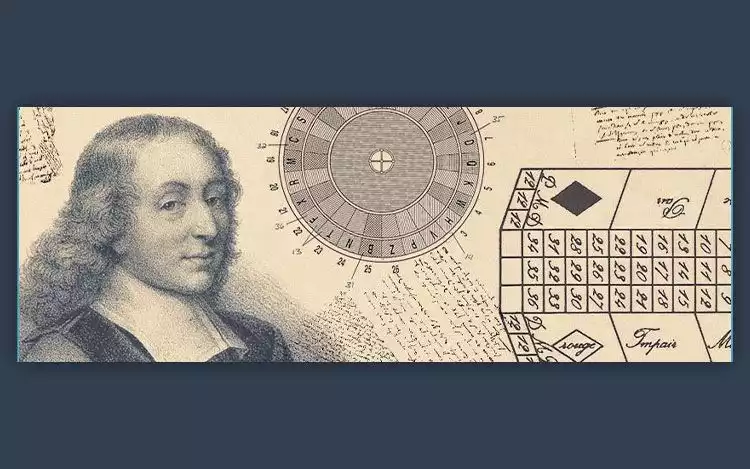
Roulette’s origins trace back to Blaise Pascal, the French mathematician and philosopher who, in the 1650s, experimented with a perpetual motion machine. Though his wheel was not a game, its design inspired the mechanism later used in roulette. Pascal’s discussions with Pierre de Fermat birthed probability theory, transforming randomness into a field of study. Every modern spin still embodies his question: can logic coexist with uncertainty?
Roulette, in this sense, began not in a casino — but in a notebook of mathematical experiments.
Roulette in the Age of Reason – The Parisian Salon Game
By the 18th century, Parisian salons became hubs for both intellectual debate and refined leisure. Roulette fit perfectly within this environment — a game that mirrored Enlightenment ideals of order and chance coexisting harmoniously.
To play was to engage in a social experiment on probability: a meeting point between logic and entertainment. For the French elite, roulette was a way to experience the elegance of uncertainty without abandoning reason.
Early French Table Design and the Rules of Fair Play
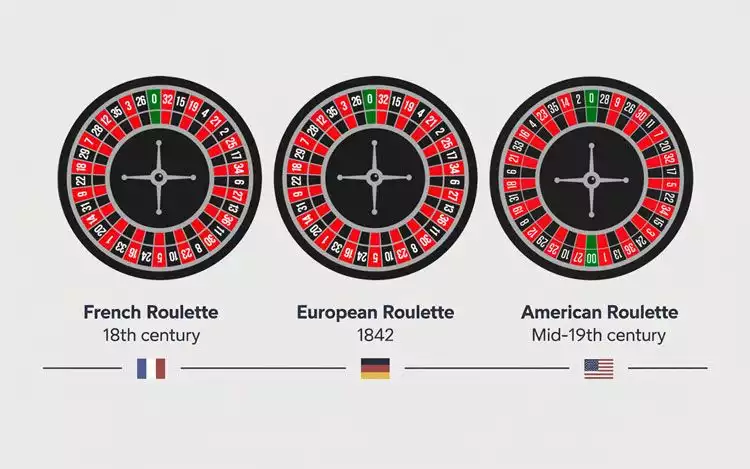
The French version distinguished itself through its mathematical ethics. The 37-pocket wheel (numbers 0–36) introduced balance and symmetry, while two key rules reflected fairness long before gambling regulation existed:
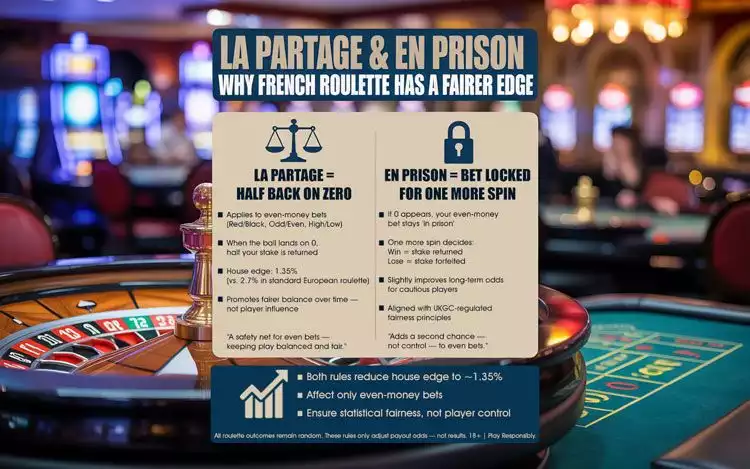
- La Partage: If the ball landed on zero, even-money bets recovered half their stake.
- En Prison: Even-money bets could remain “imprisoned” for the next spin, offering a second chance.
These mechanisms reduced the house edge to 1.35%, effectively turning French Roulette into an applied probability lesson in fairness.
Law, Morality, and Monarchy – When Chance Met Caution
Despite its appeal, roulette clashed with 18th- and 19th-century French moral codes. Rulers like Louis XV and Napoleon Bonaparte viewed gambling as a challenge to discipline and order, imposing repeated bans. Yet these restrictions only deepened fascination with the game.
Even in prohibition, roulette survived as a topic of philosophical curiosity — a study in how society governs risk and morality.
Monte Carlo – Preserving the French Tradition
When the Blanc brothers, François and Louis, established casinos in Monaco during the mid-19th century, they preserved the French system at a time when Europe’s versions were diverging.
Monte Carlo’s single-zero wheel and French layout became a widely referenced historical model for single-zero roulette design. While American roulette added a second zero, the French version stood as a model of integrity — proof that elegance and logic needed no modification.
|
📦 Roulette Fairness Reminder References to historical rules such as La Partage or En Prison describe traditional formats only. In modern online or live roulette, all outcomes are determined by certified RNG systems or audited wheels under UKGC regulation. No rules or strategies can influence the randomness of results. For support, visit BeGambleAware.org. 18+. |
Comparing the Three Versions – A Lesson in Probability
The three main versions of roulette differ not only in design but in philosophy. Below is a comparison illustrating how fairness, risk, and mathematical structure diverge:
|
Feature |
French Roulette |
European Roulette |
American Roulette |
|
Zeros |
1 |
1 |
2 |
|
Unique Rules |
La Partage, En Prison |
None |
None |
|
House Edge (Even Bets) |
1.35% |
2.70% |
5.26% |
|
Philosophy |
Fairness through logic |
Balanced gameplay |
Profit through risk |
This comparison functions as a practical lesson in expected value — a foundational concept in probability and game theory. The French system’s fairness is quantifiable, making it an ideal educational example often used to discuss probability structures in roulette.
Language of the Table – A Living Heritage
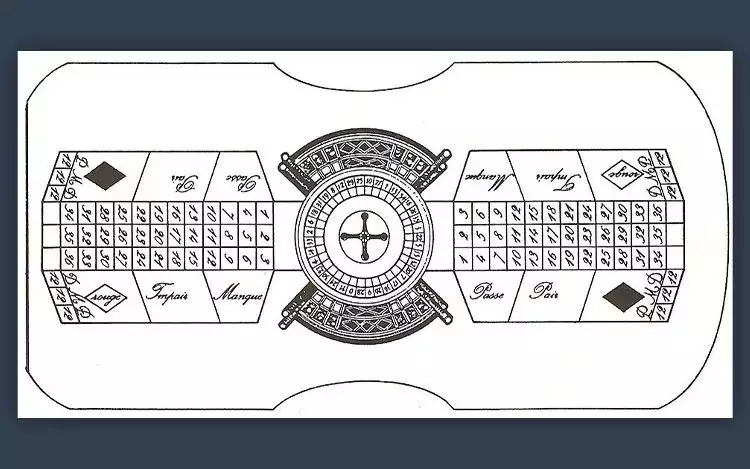
Beyond its mechanics, French Roulette carries a linguistic legacy. Traditional tables and live-dealer platforms still use French terms:
- “Impair” (odd)
- “Pair” (even)
- “Manque” (low numbers 1–18)
- “Passe” (high numbers 19–36)
These aren’t just linguistic remnants — they preserve the game’s cultural DNA. Knowing the language of the table deepens appreciation for roulette’s French origins and adds authenticity to the modern experience.
From Mechanical Wheels to Digital Transparency
Today, the spirit of French Roulette lives on in digital environments and mobile platforms.
Random Number Generator (RNG) systems replicate genuine probabilities, while third-party audits (e.g., eCOGRA, UKGC standards) ensure transparent fairness.
Live-dealer roulette brings human croupiers back into the equation, using original French calls — bridging centuries of tradition with modern regulation.
In an educational sense, French Roulette exemplifies how technological innovation can preserve, not distort, historical fairness.
Conclusion – Logic, Luck, and Legacy
French Roulette stands as more than a casino game — it’s a reflection of French intellectual heritage and the timeless pursuit of balance between reason and chance.
Key takeaways:
- Blaise Pascal’s early experiments introduced probability to the world.
- French rules like La Partage and En Prison embody fairness through logic.
- The game’s journey mirrors France’s Enlightenment ideals of order and rational play.
- Monte Carlo preserved its authenticity as the benchmark of fair design.
- Modern adaptations retain the same spirit — transparent, elegant, and educational.
Information on roulette formats can be viewed on UKGC-licensed platforms such as Prime Casino.