Published: 10 Nov 2025 | Updated: 27 Jan 2026

French Roulette is often recognised for its structured design and long-standing ruleset, and La Partage is one of the features that distinguishes it from other roulette variants. While most versions treat a zero result as a complete loss on even-money bets, La Partage returns half the stake, creating a different mathematical profile for these specific wagers.
This guide explains the rule from an educational perspective — including the maths behind it and how it fits into modern roulette design across online roulette platforms and live roulette environments .
In this article you’ll learn:
- What La Partage is and when it applies
- How the rule influences expected loss on even-money bets
- Clear numerical examples
- Why it applies only to certain bet categories
- How casinos implement it within regulated formats
- How players can approach the rule responsibly
|
📦 Disclaimer This article explains roulette rules and probability concepts for informational purposes only. It does not promote gambling, predict outcomes, or suggest advantageous play. All casino results — including online, mobile, and live dealer versions — are determined by certified RNG systems or audited physical wheels. 18+ | Play responsibly. Support: BeGambleAware.org |
What Is the La Partage Rule?
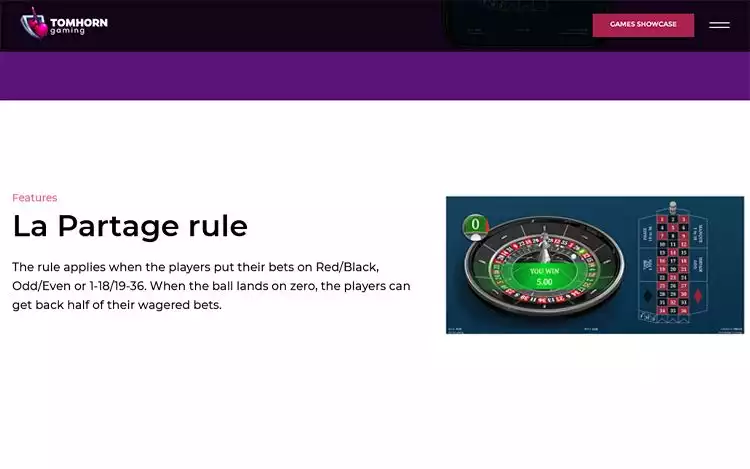
La Partage (“the sharing”) affects only even-money bets such as:
- Red / Black
- Odd / Even
- High / Low
If the ball lands on zero (0):
- Half of the stake is returned, and
- Half is retained by the house
This applies whether playing table games via a regulated online casino or a live dealer session.
Inside bets (straight up, split, corner, etc.) are not covered because their payout structures already reflect their lower probability.
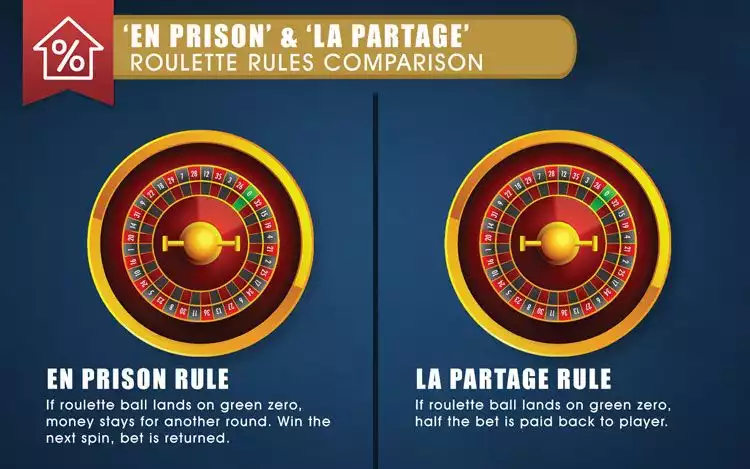
La Partage is often mentioned alongside En Prison, an alternative rule where the stake is “held” for the next spin instead of partially returned. Both rules change how even-money bets resolve in the event of a zero without altering overall randomness.
How La Partage Influences the House Edge
While the rule does not change probability, it changes how losses on a zero are treated. French and European wheels both contain 37 pockets, but the outcome handling differs.
Without La Partage (European wheel)
- Zero = full loss on even-money bets
- House edge on even-money bets ≈ 2.70%
With La Partage (French wheel)
- Zero = half-stake loss
- House edge on even-money bets ≈ 1.35%
|
Rule Type |
Wheel Pockets |
Outcome on Zero |
House Edge (Even Bets) |
|
European |
37 |
Full loss |
~2.70% |
|
French (La Partage) |
37 |
Half loss |
~1.35% |
|
American (double zero) |
38 |
Full loss |
~5.26% |
This does not give an advantage to the player; it simply reduces expected loss over time on qualifying bets.
For more detail, see: Roulette House Edge Explained
Example — 100 Even-Money Spins
Suppose a player makes £10 even-money bets for 100 spins (for illustration only):
|
Game Type |
Spins |
Approximate Loss per 100 Spins |
House Edge |
Estimated Return |
|
European |
100 |
£27.00 |
2.70% |
97.3% |
|
French (La Partage) |
100 |
£13.50 |
1.35% |
98.65% |
➡️ Interpretation: Over 100 spins, you’d lose around £13.50 less with La Partage active. Over longer play, that difference compounds — saving roughly £13.50 per £1,000 wagered on even-money bets.
For players who enjoy slower, more strategic sessions, this improved expected return translates to longer playtime and steadier bankroll management.
Why La Partage Applies Only to Even-Money Bets
Even-money wagers cover 18 of 37 outcomes, making them the most balanced category in roulette.
Inside bets, such as straight-ups or splits, target fewer numbers and already have payout ratios calibrated to match probability. Applying La Partage to those bets would distort payout structures.
Limiting the rule to even-money bets maintains the mathematical consistency of the French wheel.
La Partage vs En Prison
Both rules produce the same long-term mathematical profile for even-money bets but work differently:
|
Feature |
La Partage |
En Prison |
|
Zero Outcome |
Half stake returned |
Stake held for next spin |
|
Resolution |
Immediate |
Resolved on following spin |
|
Common In |
RNG games, standard French tables |
Live casino tables |
|
House Edge |
Same (≈1.35%) |
Same (≈1.35%) |
Neither rule changes outcomes or probabilities — they only change how zero is handled operationally.
Common Misunderstandings
To maintain clarity, here are misconceptions players sometimes have:
❌ “La Partage increases winning chances.”
→ It does not change probability. It adjusts how zero is resolved.
❌ “It applies to all bets on the table.”
→ Only even-money wagers qualify.
❌ “It can turn roulette into a break-even game.”
→ The house retains a mathematical edge under all rules.
For safe, structured approaches, explore: Roulette Strategy Overview (Educational)
Why Casinos Still Use the Rule
Many regulated casinos — including live casino formats — continue offering La Partage because:
- It preserves the historical profile of French roulette
- It supports transparency and aligns well with UKGC fairness standards
- It creates smoother volatility for players, leading to more predictable session pacing
This is part of French Roulette’s “heritage design” and is not intended to provide mathematical benefit beyond reducing the impact of zero on even-money bets.
Responsible Play Considerations
La Partage may appeal to players who prefer stable wagering patterns, but responsible play principles remain essential:
- Stick to even-money bets only if you want the rule to apply
- Use consistent, moderate stakes
- Avoid chasing losses or using progressive systems
- Always confirm the table rules before playing
- Use safer play tools on any licensed platform, including limit-setting and time reminders (Responsible Gambling Resources)
- Sessions should be time-limited, not outcome-driven
- Carefully read bonus terms and conditions
Players using mobile devices may encounter the rule in casino app formats as well .
Conclusion — A Small Rule with a Measurable Effect
La Partage does not alter randomness or change outcome probabilities. Instead, it adjusts how even-money bets resolve when the ball lands on zero, resulting in a different expected loss rate over extended sessions.
Key Takeaways
- La Partage returns half the stake on even-money bets when zero appears
- It reduces the house edge on those bets from ~2.70% to ~1.35%
- The rule does not influence outcomes or provide advantage
- French Roulette maintains one of the most structured and mathematically transparent formats
- Always use responsible gambling tools and play only with UK-licensed providers
To explore regulated French Roulette formats online, including live versions and RNG tables, visit: 👉 Prime Casino