Published: 10 Dec 2025 | Updated: 28 Jan 2026

French Roulette is often described as the most balanced form of roulette, but that reputation rests on how its odds and probabilities are structured, not on how often players win.
Understanding these concepts helps players interpret payouts correctly, avoid common misconceptions, and approach the game with realistic expectations — whether playing online, at live tables, or simply learning how roulette mathematics works.
In this guide, you’ll learn:
- What “odds” actually mean in French Roulette (and what they don’t)
- How the single-zero wheel defines probability
- Why payouts never match true mathematical odds
- How variance affects short-term results
- Why probabilities remain identical online and live
- How to interpret odds responsibly under UKGC standards
This article explains probability as context, not as a way to influence outcomes.
|
Disclaimer This guide is provided for educational purposes only. Roulette outcomes are random and cannot be influenced by player decisions or interpretations of probability. Always play responsibly and within your limits. 18+ | Play responsibly | BeGambleAware.org |
What “Odds” Mean in French Roulette
In roulette, “odds” refer to payout ratios, not the likelihood of a result occurring. A 35:1 payout does not mean a number has a 1-in-35 chance of landing.
French Roulette outcomes are determined by a random number generator (RNG) in online play or a physical wheel in live dealer formats. Each spin is independent, and odds never change based on previous results.
This distinction is essential when playing regulated online roulette, where outcomes are audited for randomness and fairness.
The Single-Zero Wheel and Probability Distribution
French Roulette uses a single-zero wheel with 37 numbers (0–36). This structure defines every probability in the roulette game.
Each number has:
- A probability of 1 / 37 (≈2.70%)
- No memory of past spins
- Equal likelihood on every round
Because the zero is neither red nor black, nor odd nor even, it creates a small mathematical imbalance. That imbalance — not player behaviour — is what generates the casino’s edge.
This structure is identical across licensed casino platforms offering French Roulette.
Probability vs Payout: Why They Never Match Perfectly
If roulette payouts matched true probability, the game would be neutral. Instead, payouts are deliberately set slightly lower than statistical fairness.
Example:
- A straight-up bet covers 1 number
- True odds: 36:1
- Actual payout: 35:1
That single-unit difference exists across all bet types. It ensures the casino retains a consistent margin over time, regardless of which bets are placed.
This design is universal across table games, not unique to roulette.
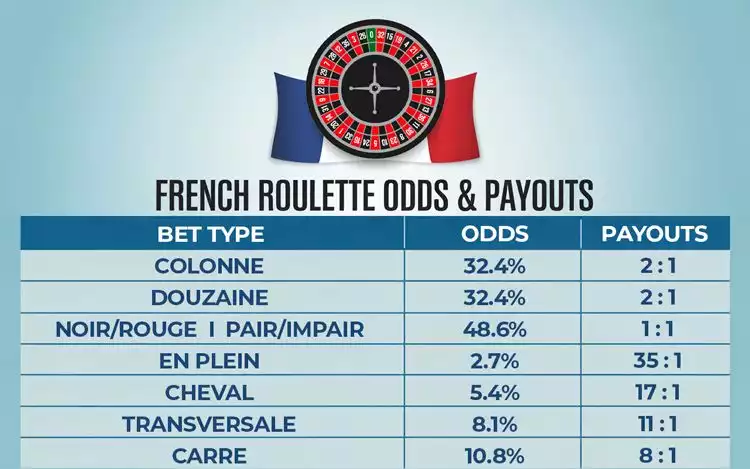
Odds Breakdown by Bet Type (Inside vs Outside)
Different bets affect volatility, not probability bias.
- Inside bets (straight-up, split, street)
- Lower hit frequency
- Higher payout variance
- Outside bets (red/black, odd/even, dozens)
- Higher hit frequency
- Lower variance
What does not change:
- The randomness of outcomes
- The independence of spins
- The regulated fairness of the game
Understanding this distinction helps players interpret results without assuming patterns or predictability.
Short-Term Variance vs Long-Term Probability
Roulette often feels unpredictable in short sessions. This is due to variance, not changing odds.
Short-term variance can include:
- Repeated colours
- Clusters of high or low numbers
- Apparent streaks
Over long periods, results converge toward expected probabilities. This convergence is mathematical, not guaranteed within any specific session.
Variance explains why roulette feels streaky — without implying bias or opportunity.
Expected Value Explained in Plain Terms
Expected value (EV) describes the average outcome of a bet over time, not the result of a single spin.
In French Roulette:
- EV is consistent across bets
- No bet alters the underlying probability
- Lower house edge affects rate of loss, not likelihood of winning
EV is a statistical concept used to understand game structure, not to guide predictions or betting behaviour.
For a deeper explanation of margin mechanics, see this guide to the roulette house edge.
Common Probability Misconceptions in Roulette
Several persistent myths arise from misunderstanding probability:
- “A number is due”
- “Red has hit too often”
- “The wheel balances itself”
In reality:
- Each spin is independent
- Past results have no effect
- Probability resets every round
These misconceptions are examples of the gambler’s fallacy, a well-documented cognitive bias — not a property of roulette itself.
Odds Awareness in Online and Live French Roulette
Odds and probabilities are identical whether you play:
- RNG-based French Roulette
- Live dealer roulette streams
- Mobile or desktop formats
Technology changes presentation, not mathematics.Licensed live dealer tables and digital versions follow the same probability model and regulatory standards.
Accessibility via mobile platforms does not alter randomness or outcomes.
Responsible Interpretation of Odds and Probabilities
Understanding odds should support informed, controlled play, not expectation of outcomes.
French Roulette is designed as structured entertainment:
- Outcomes are random
- Probabilities are fixed
- No strategy can change results
Players are encouraged to approach roulette with awareness, pacing, and use of available tools for responsible gaming.
For guidance on safe play practices, limits, and support, refer to licensed resources before engaging in any promotions or bonuses.
Conclusion: What Odds Really Tell You in French Roulette
French Roulette odds and probabilities explain how the game is built, not how to beat it.
They reveal:
- Why the game is mathematically consistent
- How variance affects perception
- Why outcomes remain fair but unpredictable
Key Takeaways
- Odds describe payouts, not likelihood
- The single-zero wheel defines all probabilities
- Payouts are lower than true odds by design
- Variance explains streaks without bias
- Expected value measures structure, not results
- Responsible play begins with correct interpretation
To explore French Roulette within a regulated environment offering online, live, and educational resources, visit Prime Casino.
|
Disclaimer This article is for educational purposes only. It does not promote gambling strategies or guarantee outcomes. All roulette games are governed by RNG or mechanical randomness under UKGC regulation. 18+ | Play Responsibly | BeGambleAware.org |