Published: 8 Dec 2025 | Updated: 28 Jan 2026

French Roulette payouts can appear confusing at first — different bet types, payout ratios, and special rules like La Partage all affect what you actually receive after a spin.
So how do French Roulette payouts really work, and how can you calculate them correctly without relying on guesswork or common myths?
French Roulette follows a fixed mathematical structure used across online roulette formats available at a UK-licensed online casino. Every payout is determined by probability, table layout, and predefined ratios — not patterns, timing, or player behaviour. Understanding how these calculations work helps players interpret results accurately, understand spending over time, and approach the game with realistic expectations.
In this guide, you’ll learn:
- How French Roulette payout ratios are calculated
- How to work out potential winnings for inside and outside bets
- Why probability — not prediction — determines returns
- How La Partage and En Prison affect even-money bets
- How to understand potential payouts without complex formulas
For a broader overview of the game’s structure and rules, see our
👉 Complete Guide to French Roulette
|
Disclaimer: This article is for educational purposes only. It does not provide gambling strategies or methods to influence outcomes. All roulette spins are random and independent. Always play responsibly. 18+ only | BeGambleAware.org |
The Math Behind Payouts in French Roulette
At its core, French Roulette is governed by probability. The wheel contains 37 pockets (numbers 0–36). When you place a bet, your chance of winning depends entirely on how many numbers that bet covers.
The general payout formula is:
Winnings=Stake×Payout Ratio
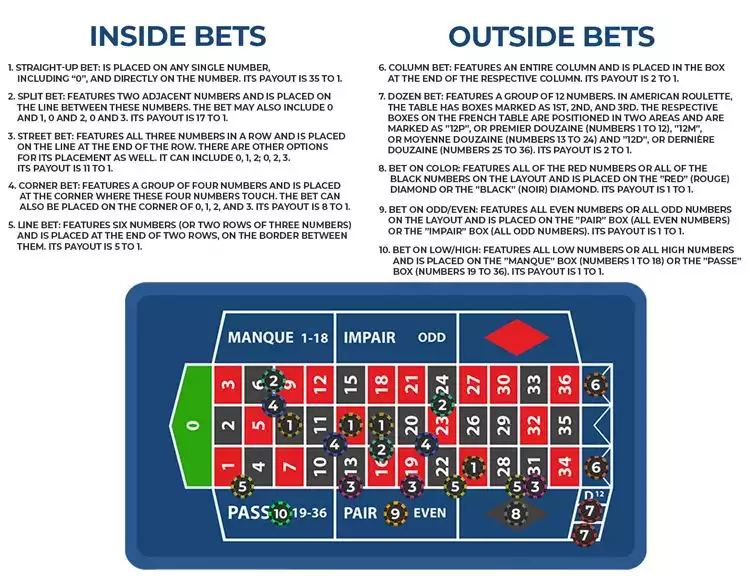
Each bet type has a fixed ratio based on its likelihood of success. For example, a straight-up bet on a single number pays 35:1, meaning you receive 35 times your stake as profit if that number hits.
Because the wheel includes a single zero, the true probability is 1 in 37, not 1 in 36. This difference creates the house edge built into the game.
These same calculations apply whether the game is delivered via RNG software or live roulette with a professional dealer in regulated live casino environments.
If you want to understand how this affects returns across roulette variants, see:
👉 Roulette House Edge Explained
Step-by-Step: Calculating Each Bet Type
Using a £10 stake, the table below shows how common French Roulette bets are calculated.
|
Bet Type |
Numbers Covered |
Win Probability |
Payout Ratio |
Example (£10 Bet) |
|
Straight-up |
1 |
1/37 |
35:1 |
£350 |
|
Split |
2 |
2/37 |
17:1 |
£170 |
|
Street |
3 |
3/37 |
11:1 |
£110 |
|
Corner (Square) |
4 |
4/37 |
8:1 |
£80 |
|
Line (Six Line) |
6 |
6/37 |
5:1 |
£50 |
|
Dozen / Column |
12 |
12/37 |
2:1 |
£20 |
|
Even-Money (Red/Black, Odd/Even, 1–18/19–36) |
18 |
18/37 |
1:1 |
£10 (£5 returned on 0) |
If you’re new to table layouts and bet placement, this breakdown pairs well with guides covering table games and roulette bet structures:
👉 French Odds and Probabilities Explained
Expected Value and Long-Term Perspective
Roulette payouts are best understood over time rather than on individual spins. This is where expected value (EV) is useful. EV represents the average amount won or lost per bet over many repetitions.
EV = (Pwin x Win Amount) - (Ploss x Stake)
For a £10 straight-up bet, the calculation shows a long-term average loss reflecting the built-in house edge.
This concept is explored further in:
👉 French Roulette: Lowest House Edge Explained
Note: Expected value does not predict short-term results.
It describes long-term averages across many spins.
La Partage & En Prison Explained
French Roulette includes two unique rules that reduce losses on even-money bets:
- La Partage: If zero appears, half your stake is returned immediately.
- En Prison: Your bet is held for the next spin. If it wins, you recover the stake with no profit or loss.
Both rules reduce volatility, but neither alters the randomness or fairness of the wheel.
For a deeper comparison of these rules, see:
👉 La Partage vs En Prison Explained
Quick FAQ: French Roulette Payouts
What makes French Roulette payouts different?
The single-zero wheel and La Partage rule reduce losses on even-money bets.
👉 Why French Roulette Is The Best Variant
Are inside bets better than outside bets?
Neither is better — they involve different risk and return profiles.
Does understanding payouts improve results?
It improves understanding and expectation management, not outcomes.
Responsible Play: Knowledge Over Impulse
Understanding payout mechanics isn’t about maximising winnings — it’s about making informed, responsible choices. Every roulette spin is random, but the maths behind payouts is fixed and transparent.
The same rules apply whether you play on desktop or through a licensed mobile app. Players should always set limits and use available responsible gaming tools to manage play.
Some platforms may also list promotions and bonuses separately. These are optional and do not affect roulette payouts, probabilities, or calculations.
|
Responsible Gambling Reminder: Roulette is a game of chance. No calculation or system can influence results. Always play within your means and use responsible gambling tools. For support, visit BeGambleAware.org. 18+ | Play Responsibly |
Conclusion — Understanding Payouts, Not Predicting Outcomes
French Roulette payouts are governed by probability, fixed ratios, and clearly defined rules. While no calculation can influence where the ball lands, understanding how payouts are calculated provides clarity, perspective, and control.
Key Takeaways
- All French Roulette payouts are mathematically fixed
- Inside bets offer higher payouts with lower probability
- Outside bets trade lower returns for more frequent wins
- La Partage and En Prison reduce losses, not randomness
- Payout knowledge supports responsible play, not prediction
For players exploring regulated environments, you can review verified French Roulette tables and educational resources at 👉 Prime Casino