Published: 17 Dec 2025 | Updated: 28 Jan 2026


The Martingale strategy is one of the most widely discussed betting systems in roulette — particularly among players exploring online roulette and live roulette formats at a regulated online casino.
At its core, Martingale is a progression system built on a simple idea: increase your bet after a loss so that the first win recovers all previous losses plus a small profit. While the logic appears intuitive, its real-world implications are often misunderstood.
This pillar guide explains how Martingale actually works, where it came from, and why its perceived simplicity can mask significant risk — particularly when applied to modern table games and live casino environments.
In this article, you’ll learn:
- What the Martingale strategy is — and what it is not
- Where Martingale betting originated
- A step-by-step example of Martingale applied to roulette
- Why some players are drawn to Martingale systems
- Common misconceptions that surround Martingale betting
|
Disclaimer: This article is educational in nature and does not promote betting systems as a way to overcome the house edge. Roulette outcomes are always determined by chance. Always play responsibly. For support, visit BeGambleAware.org. 18+ |
What Is the Martingale Strategy?
The Martingale strategy is a negative progression betting system. After every losing bet, the stake is doubled. When a win eventually occurs, it offsets all previous losses and yields a profit equal to the original stake.
In roulette, Martingale is most commonly applied to even-money bets, such as red/black or odd/even, because these bets have the highest probability of winning on a single spin.
However, probability does not equal certainty — and roulette outcomes remain governed by a fixed house edge that applies on every spin, regardless of betting pattern.
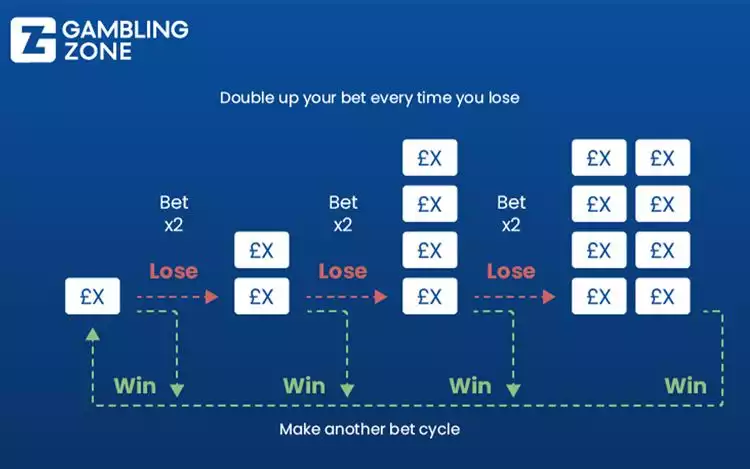
Step-by-Step Example of Martingale in Roulette
To illustrate how Martingale works, consider a simplified example using a red/black bet:
- Bet £10 on red
- Lose → next bet £20
- Lose → next bet £40
- Win → recover £70 in losses + £10 profit
On paper, the sequence appears manageable. In reality, losing streaks occur naturally in random systems, and bet sizes escalate rapidly.
This is especially relevant in live dealer environments, where table limits are strictly enforced and long sessions are common.
Why Players Use Martingale
Martingale remains popular for several reasons:
- It is easy to understand
- Short-term wins occur frequently
- Losses feel “recoverable” after a win
- It creates a sense of structure in betting
These factors make Martingale appealing to players seeking a defined strategy — even though the system does not change expected outcomes.
Common Misunderstandings About Martingale
Several myths persist around Martingale betting:
- “It guarantees a win.”
It does not. It increases exposure, not probability.
- “Losses can’t continue forever.”
Losing streaks are a natural feature of randomness.
- “It beats roulette in the long run.”
The house edge applies to every spin independently.
Martingale does not influence the wheel, the ball, or outcome distribution — whether playing via desktop or mobile.
Where Players Go Wrong With Martingale
The primary risks associated with Martingale include:
- Rapid bankroll depletion
- Table betting limits
- Emotional loss-chasing
- Overconfidence after short winning runs
These factors explain why many players eventually move away from the system altogether.
A deeper examination of these concerns is explored in Why Some Players Avoid the Martingale Betting System, which focuses on long-term sustainability and player experience.
Can Casinos Detect Martingale Betting?
While Martingale is not illegal, casinos can monitor betting behaviour — particularly online, where patterns are easier to analyse.
This topic is covered in detail in Can Casinos Detect Players Using Martingale, and How?, which explains surveillance, pattern recognition, and player privacy considerations in licensed environments.
Is Martingale Worth Using in Online Roulette?
Whether Martingale is “worth it” depends on expectations.
Players interested in weighing both sides should review The Pros and Cons of Using Martingale for Online Roulette, which compares perceived advantages against mathematical and practical limitations.
It is also worth understanding Why Martingale Is Popular but Risky in Roulette Betting, which explores the psychological appeal of progression systems and why popularity does not equal effectiveness.
The Origins of Martingale Betting
The Martingale system dates back to 18th-century France and is rooted in early probability theory. It was originally discussed as a theoretical model, not as a practical gambling solution.
In mathematical terms, Martingale assumes:
- Unlimited bankroll
- No betting limits
- Infinite time
None of these conditions exist in real casino environments — whether playing digitally or through a dealer-led stream.
Modern roulette rules, table limits, and bankroll constraints fundamentally change how the strategy performs in practice.
Responsible Play and Expectations
Martingale does not overcome variance, probability, or the house edge. It simply changes how risk is distributed over time.
Responsible play means:
- Understanding betting limits
- Managing bankroll realistically
- Accepting that losses are part of chance-based games
- Choosing platforms that promote safe play
Players are encouraged to responsibly play and use available tools to manage time and spend.

Conclusion: Understanding Martingale in Roulette
The Martingale strategy is simple in concept but complex in consequence. While it offers a clear betting structure, it does not change the underlying mathematics of roulette or remove risk. Instead, it redistributes exposure over time, increasing stakes during losing streaks that occur naturally in random games.
Understanding how Martingale works helps players approach roulette with realistic expectations and avoid treating betting systems as a substitute for probability or discipline.
Key Takeaways
- Martingale is a negative progression system based on doubling after losses
- It does not influence outcomes or reduce the house edge
- Losing streaks are statistically inevitable and can escalate bets quickly
- Bankroll limits and table maximums fundamentally restrict the system
- Martingale may increase financial and emotional pressure rather than control
Roulette remains a game of chance, not optimisation. Players are best served by informed play, clear limits, and viewing the game as entertainment rather than a system-driven pursuit. For regulated access to roulette formats, responsible tools, and transparent play conditions, explore Prime Casino.