Published: 22 Dec 2025 | Updated: 28 Jan 2026

Online gambling is designed to be accessible and fast-moving, which makes regular self-reflection an important part of informed participation. For UK players, understanding when gambling activity may be shifting from entertainment toward potential harm is a key aspect of player protection and consumer rights within a regulated online casino environment.
This article explains common, research-backed indicators that may suggest the need for a gambling break, alongside an overview of the tools typically available to help players manage their activity responsibly.
This article covers:
- Behavioural and emotional signs linked to gambling harm
- How gambling breaks and self-exclusion tools function
- The role of reality checks and play limits
- Practical considerations for players using online gambling platforms
|
Disclaimer: This article is provided for educational purposes only. Online casino games operate using random number generators, and outcomes are determined by chance. No strategy or approach can influence results. Always play responsibly. For support, visit BeGambleAware.org. 18+ only. |
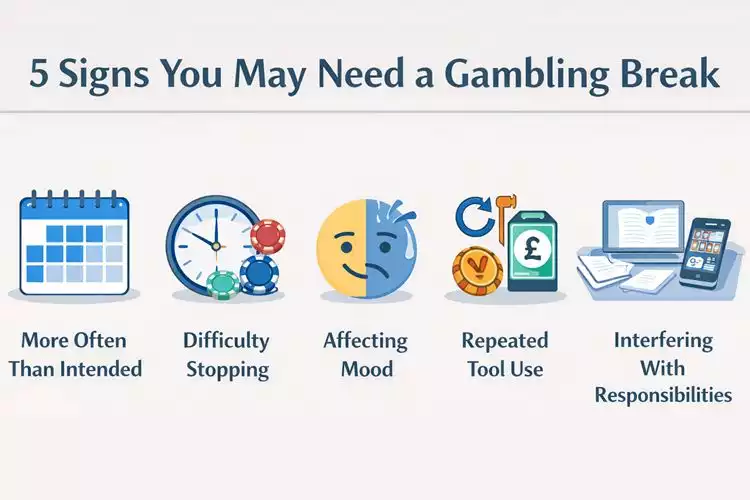
Gambling More Often Than Intended
One of the earliest indicators identified in gambling research is a gradual increase in gambling frequency or session length beyond original intentions. This does not necessarily involve high spending but may include logging in more often, extending sessions, or feeling drawn back shortly after stopping.
Academic studies on gambling behaviour note that increased frequency is commonly associated with reduced self-regulation, particularly in online environments where access is continuous and frictionless. This pattern can occur across different formats, including standard online casino games, live casino tables, or digital slot-based games.
When gambling begins to feel habitual rather than deliberate, a short break can provide space to reassess motivations and restore balance.
Difficulty Stopping or Taking Breaks
Another commonly reported sign is finding it difficult to stop gambling once a session has started, even when time or spending limits were set in advance. Research into harm-minimisation tools highlights that impaired control is a core feature of gambling-related harm rather than a failure of willpower.
This difficulty may present as:
- Ignoring internal reminders to stop
- Continuing play after intended limits are reached
- Repeatedly postponing planned breaks
Online platforms typically offer optional tools such as session reminders and enforced breaks, which are designed to interrupt extended play patterns. When these tools feel necessary rather than optional, it may indicate that stepping away entirely for a period could be beneficial.
Gambling Affecting Mood or Wellbeing
Changes in emotional responses linked to gambling activity are another important indicator discussed in academic literature. These may include irritability, restlessness, or low mood when not gambling, or using gambling sessions as a way to cope with stress or negative emotions.
Research has shown that emotional reliance on gambling can develop independently of financial outcomes. In these cases, gambling is no longer functioning purely as entertainment but as a mood-regulation mechanism, which increases the risk of harm over time.
Taking a gambling break allows individuals to observe whether emotional wellbeing improves in the absence of play and whether alternative coping strategies feel more effective.
Repeated Use of Responsible Gambling Tools Without Lasting Effect
Modern online gambling platforms are required to provide a range of harm-minimisation tools, including deposit limits, loss limits, and reality checks. Evidence-based reviews suggest these tools are most effective when used proactively rather than reactively.
A potential warning sign occurs when:
- Limits are repeatedly increased after being reached
- Multiple tools are activated without reducing gambling frequency
- Short-term exclusions are used frequently
This pattern may suggest that structural tools alone are not sufficient and that a longer, enforced break—such as self-exclusion—could provide clearer boundaries. Information about safe play options is typically available through responsible gambling sections such as those found on regulated platforms like casino operators.
Gambling Interfering With Daily Responsibilities
The final commonly cited indicator involves gambling beginning to interfere with everyday responsibilities or routines. This may include disrupted sleep, reduced focus at work, or avoiding social commitments due to gambling sessions.
Academic research on self-exclusion consistently identifies functional impairment—rather than spending alone—as a critical marker for when intervention is appropriate. This applies regardless of the format used, whether via desktop or mobile access.
At this stage, a structured gambling break can help re-establish routines and clarify whether gambling remains a manageable leisure activity.
Conclusion
Recognising the need for a gambling break is not about assigning fault but about understanding how gambling behaviour can change over time. Research consistently shows that early awareness and timely use of protective tools—such as play limits, reality checks, or self-exclusion—can reduce the risk of long-term harm.
Taking a break allows players to reassess their relationship with gambling in a neutral, informed way, particularly within regulated environments that also offer products such as live casino games and online slots.
Key Takeaways
- Increased frequency or longer sessions can signal reduced control
- Difficulty stopping is a recognised indicator of gambling-related harm
- Emotional reliance on gambling is a key risk factor identified in research
- Repeated use of limits without effect may suggest stronger measures are needed
- Gambling should not interfere with daily responsibilities or wellbeing
For UK players seeking general information on safer gambling tools and platform standards, resources are available through regulated operators such as Prime Casino, alongside independent support services focused on responsible play.