Published: 19 Dec 2025 | Updated: 28 Jan 2026


The Martingale betting system remains one of the most talked-about approaches in online roulette — not because it changes the odds, but because it feels intuitive.
At first glance, Martingale appears logical: double your bet after a loss, recover everything with one win, and return to your starting stake. This simplicity explains why the system continues to attract players at both digital tables and regulated online casino platforms.
However, popularity does not equal safety. This article explains why Martingale appeals to players, while also examining the real risks that sit beneath its surface.
In this article, you’ll learn:
- Why Martingale feels convincing to many players
- How the idea of “guaranteed recovery” creates false confidence
- The hidden risks behind short-term success stories
- Why long-term outcomes remain unchanged
- How to approach Martingale responsibly, if at all
|
Disclaimer: This content is intended for educational purposes only and does not promote or encourage gambling systems. The Martingale strategy discussed here does not alter game odds or guarantee outcomes. Readers are advised to treat roulette and all forms of gambling as entertainment, not as a method of financial recovery or investment. For support, tools, and guidance on responsible gambling, visit BeGambleAware.org. 18+ |
Why Martingale Appeals to Players
Martingale’s appeal lies in its simplicity.
Players are drawn to the idea that:
- Losses are temporary
- One win can undo multiple losses
- The system feels structured and controlled
In fast-paced games like roulette or live roulette, this structure can feel reassuring — especially to newer players seeking order in randomness.
The system also offers frequent small wins, reinforcing the perception that it “works,” at least initially.
The Illusion of Guaranteed Wins
One of the most powerful psychological hooks of Martingale is the belief that a win is inevitable.
This belief stems from:
- Misunderstanding randomness
- Underestimating losing streak probability
- Confusing short-term variance with certainty
While it’s true that a win will eventually occur, there is no guarantee it will occur before bankroll or table limits are reached.
Every spin remains independent, governed by probability rather than previous outcomes.
Risks Hidden Behind Martingale’s Popularity
Martingale’s risks are not always visible early on.
Key hidden dangers include:
- Exponential bet growth after consecutive losses
- Rapid exposure to high-value bets
- Emotional escalation as stakes rise
What begins as a low-risk session can quickly turn into high-pressure play, particularly across table games where table limits are enforced.
Short-Term Wins vs Long-Term Reality
Many players cite short-term success as evidence of Martingale’s effectiveness.
In reality:
- Small wins occur frequently
- Large losses occur infrequently but decisively
- One losing run can erase many winning sessions
This imbalance explains why Martingale stories often include long periods of stability followed by a sudden, significant loss.
Understanding the fixed house edge clarifies why long-term expectations never shift, regardless of system design.
Table Limits and Structural Constraints
All roulette tables impose maximum bet limits.
These limits:
- Cap how far bets can be doubled
- Prevent infinite progression
- Break the recovery assumption
Once the limit is reached, the system can no longer function as intended — a reality that applies equally to RNG games and live casino formats.
Psychological Drivers Behind Martingale’s Popularity
Martingale aligns closely with several common cognitive biases:
- Illusion of control
- Loss aversion
- Desire for closure after losing
These biases make the system emotionally compelling, even when players intellectually understand the risks.
The availability of quick access via mobile play can intensify this effect by shortening decision time between bets.
Responsible Gambling and Martingale
Because Martingale increases exposure rapidly, responsible play is essential.
Players are encouraged to:
- Set strict loss limits
- Avoid chasing outcomes
- Treat roulette as entertainment, not recovery
Resources designed to help players responsibly play exist to support informed decision-making, regardless of betting approach.
Understanding Strategy vs Control
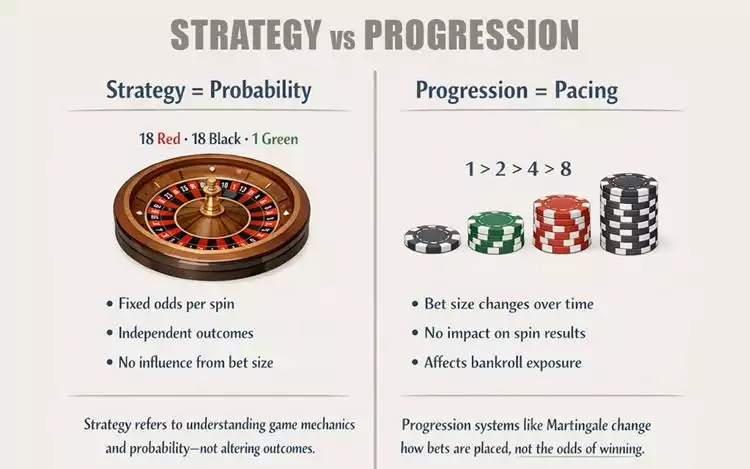
Martingale is often described as a roulette strategy, but it’s more accurately a betting progression, not a method of influencing outcomes.
Educational guides on roulette strategy consistently emphasise:
- No system alters probability
- Structure affects pacing, not results
- Control comes from limits, not doubling
This distinction is critical for realistic expectations.
Conclusion: Why Martingale Is Popular but Risky
Martingale remains popular because it feels logical, structured, and reassuring — but its risks are inherent and unavoidable.
Key Takeaways
- Martingale appeals through simplicity and frequent small wins
- The idea of guaranteed recovery is misleading
- Exponential bet growth creates sudden, severe risk
- Table limits and bankroll constraints break the system
- Long-term outcomes remain unchanged
Understanding why Martingale is popular — and why it’s risky — helps players approach roulette with clarity rather than assumption.
For transparent rules, licensed roulette games, and player protection tools, visit Prime Casino.