Published: 10 Jan 2026 | Updated: 23 Feb 2026


Progressive jackpots are among the most recognisable prize formats in the modern online casino environment. Unlike fixed prizes, progressive jackpots increase over time as players place qualifying wagers, creating prize pools that can reach substantial values before they are won.
This article explains:
- What progressive jackpots are and how they accumulate
- The difference between standalone and networked jackpot systems
- How jackpot wins are triggered
- The regulatory standards governing progressive jackpots for UK players
|
Disclaimer: This article is provided for educational purposes only. Online casino games and live casino offerings operate using random number generators, and outcomes are determined by chance. No strategy or approach can influence results. |
What Is a Progressive Jackpot?
A progressive jackpot is a prize pool that grows incrementally each time a qualifying wager is placed. A small percentage of each stake is automatically added to the jackpot, increasing its total until a predefined winning condition is met.
Progressive jackpots are most commonly associated with online slots, where automated systems track contributions and update the displayed jackpot value in real time. The fundamental structure of progressive jackpots is consistent across licensed platforms, regardless of game theme or volatility.
How Progressive Jackpots Grow
Progressive jackpots grow through a predefined contribution rate, which specifies what portion of each qualifying wager feeds into the jackpot pool. This process is continuous and automated, with contributions added instantly after each qualifying bet.
These systems function consistently across desktop, mobile, and app-based environments. The jackpot amount displayed to players is synchronised across all participating platforms.
UK Gambling Commission technical standards require that jackpot calculations are accurate, auditable, and protected against system faults or manipulation.
Standalone vs Networked Progressive Jackpots
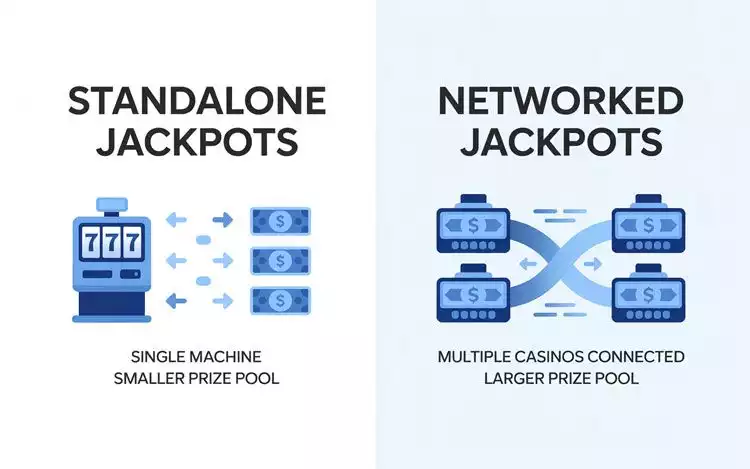
Progressive jackpot systems are generally categorised as either standalone or networked.
Standalone Progressive Jackpots
Standalone jackpots are limited to a single game within one casino. Only wagers placed on that specific game contribute to the jackpot, which typically results in smaller prize pools and more frequent resets.
Networked Progressive Jackpots
Networked jackpots link the same game across multiple casinos. Because contributions come from a wider pool of players, these jackpots can grow significantly larger before a win occurs.
Progressive jackpot mechanics are most commonly applied to slot games and are not used in live casino or live dealer formats, which follow different payout and risk models.
How Progressive Jackpots Are Won
Progressive jackpots are won based on clearly defined trigger conditions that are disclosed within the game rules. Common trigger mechanisms include:
- Random triggers, where a jackpot may be awarded on any qualifying spin
- Symbol-based triggers, where a specific symbol combination activates the jackpot
All trigger mechanisms must comply with UK regulatory requirements, including the use of certified random number generators where applicable and transparent disclosure of jackpot conditions.
It is also important to note that not all wagers qualify for progressive jackpot contributions or wins. In some cases, bets placed using a bonus or as part of a casino promotion may be excluded, depending on the game rules and promotional terms, which must be clearly disclosed to players.
Why Progressive Jackpots Can Reach Very Large Amounts
Large progressive jackpots are typically the result of sustained player activity combined with extended periods without a jackpot being triggered. Networked jackpots benefit most from this effect, as contributions continue across multiple casinos and platforms.
Although very large wins are sometimes publicly reported, such outcomes remain statistically rare. Players are encouraged to responsibly play and to view progressive jackpots as a form of entertainment rather than a predictable outcome.
FAQ: Progressive Jackpots Explained
Are progressive jackpots always won randomly?
Not always. Some progressive jackpots are triggered randomly, while others require a specific symbol combination. The trigger method depends on the game design and must be clearly stated in the rules.
Does every spin contribute to the jackpot?
Only qualifying wagers contribute to the jackpot. Some games require a minimum stake or specific bet configuration for a contribution to apply.
Can a progressive jackpot reach a maximum limit?
Most progressive jackpots do not have a fixed upper limit. However, some games may include a guaranteed minimum or seed amount that applies after a win.
Are progressive jackpots regulated in the UK?
Yes. Progressive jackpot systems offered to UK players must comply with UK Gambling Commission technical standards covering fairness, transparency, and system integrity.
Do progressive jackpots affect regular game payouts?
The jackpot contribution is typically built into the game’s overall payout structure. This means standard payouts and jackpot contributions are accounted for within the game’s design, rather than being added separately.
Summary
Progressive jackpots work by pooling small contributions from many individual wagers into a single, continuously growing prize fund. These jackpots may be standalone or networked, grow automatically through predefined contribution rates, and operate under strict technical and regulatory standards in the UK.
Key Takeaways
- Progressive jackpots increase every time a qualifying wager is placed
- Networked jackpots grow faster due to wider player participation
- Jackpot wins are triggered by clearly defined random or rule-based mechanisms
- Progressive jackpots are most commonly found in slot games, not live dealer formats
- Large jackpot wins are rare and determined entirely by chance
For players seeking further educational resources on regulated casino systems and game structures, Prime Casino provides information aligned with UK gambling standards.